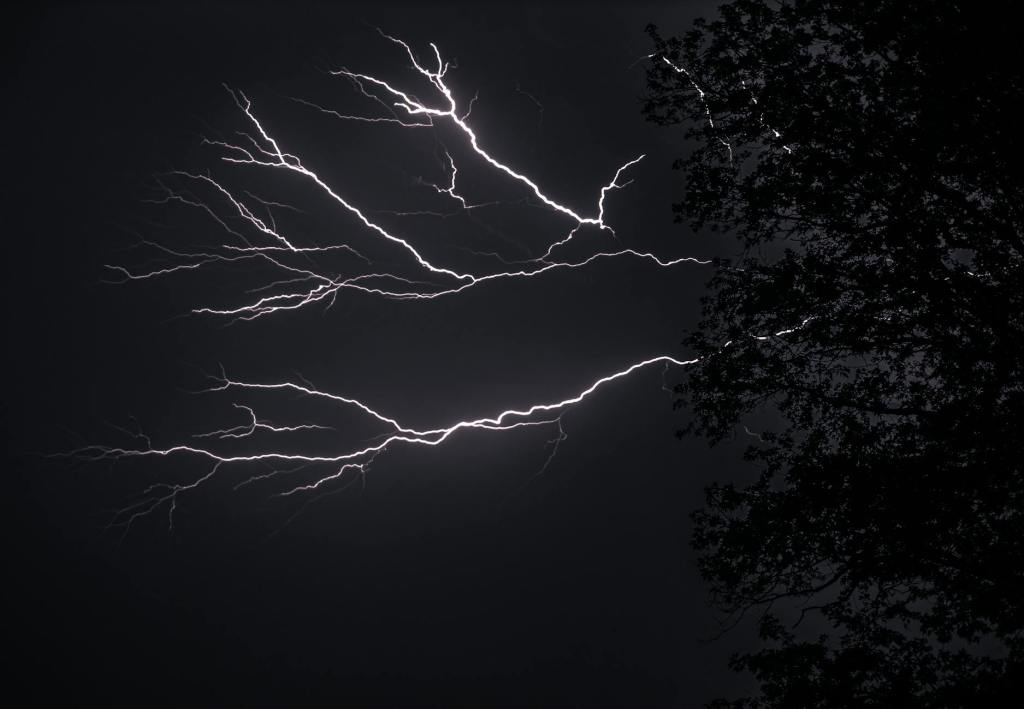
Electricity is one of those generic words which is so vaguely and inconsistently defined as to be unhelpful in any discussions of the thing itself. Is it the movement of electrons through a conductor? Well, yes, but there’s more to it than that. Is it the same as lightning? Kind of, but not necessarily. What about electromagnetic radiation? Or static electricity? What are those, and where do they fit in? These, and many more questions, quickly confuse and obfuscate any attempt to produce a concise definition of the phenomenon. The most helpful question to ask is not so much “what is electricity?” as “what does electricity do?“. What are the fundamental properties of electricity? How does it behave in different conditions? How can we use it effectively?
Four Keys to Understanding Electricity
I believe that there are four essential concepts which need to hover in the back of your mind if you desire to study electricity:
1. Mathematics
Electricity is a physical phenomenon. But like most physical phenomena, the language of mathematics often provides the most accurate translation of its behaviour. I’m aware that many people have mixed feelings about mathematics. This is why popular explanations of electricity tend to shy away from the robust descriptions which it offers. However, they can suffer from a shallowness which is frustrating for those who wish to dig deeper. Mathematics may leave you scratching your head, but a little head scratching is good for you. On a practical level, I would recommend, at a minimum, a strong familiarity with a high school level of mathematics education. This includes trigonometry, basic algebra, and the fundamentals of calculus. For example, the following equations will hopefully look familiar:
If they don’t, I would recommend brushing up on your knowledge of these topics before proceeding. This will enable you to derive a good measure of satisfaction from your exploration, without requiring a Herculean effort.
2. Abstraction
Electricity is difficult to explain succinctly. One reason for this is that electricity has many properties, which manifest themselves very differently in different situations. The way we understand electricity in an electric circuit, at face value, bears little resemblance to lightning. It’s impossible for the human mind to retain a conscious awareness of every aspect of electricity simultaneously. So we employ the principle of abstraction. Abstraction allows us to focus on the specific aspect of electricity which is relevant to our query. We know that electricity is more than this one aspect, but this one aspect is sufficient for our consideration.
Let me illustrate with the example of a banquet. If you were to host a banquet, you would have a lot to think about. However, the principle of abstraction might simplify matters. One issue to address is ingredients. You need to write a very long shopping list and send somebody to buy all these ingredients. But did you notice that you’ve already applied abstraction? You didn’t consider how to farm the ingredients or transport them to the supermarket. Instead, you treated them as items which existed in the supermarket for you to purchase.
Let’s continue planning the banquet. Now you need to decide what to serve for each course. You look through a recipe book and choose the meals which suit the occasion. You’ve applied abstraction for a second time. You treat each meal as an item to be arranged in the banquet. You know that meals are made up of ingredients, but when you’re planning each course of the banquet you don’t need to be conscious of this. Finally, you need to figure out when each course will be served. You write a schedule to ensure that the guests will be well fed for the entire evening. Once again, abstraction comes to your aid. You can temporarily forget that courses are made up of meals and meals are made up of ingredients and ingredients need to be farmed. Each course is a black box to be placed somewhere on your schedule.
This culinary thought experiment demonstrates how we should approach electricity. Understanding electricity involves electrons and fields and waves and strange pictures. We cannot comprehend these things all at once. But we do not need to. We can use abstraction to concentrate our efforts on one idea at a time.
3. Modelling
You are familiar with the concept of modelling, even if you don’t realise it. A diorama of a new skyscraper and the stage of a theatre production are both models. But a set of mathematical equations can also be a model. What these three things have in common is that they accurately describe one aspect of something and disregard other aspects. The diorama shows what the building will look like, but not how big it is, or what is inside it. The stage shows what a location looks like, but not what materials are used in its construction, or what it smells like to be there. In the same way, a set of equations can describe one aspect of electricity and disregard others. For example, Ohm’s law accurately describes the relationship between voltage, current, and resistance in an electric circuit. It tells you nothing about electromagnetic radiation or the signal to noise ratio. But that does not diminish its usefulness.
You will encounter many equations and other models in your study of electricity. None of them will be perfect because each of them will neglect something about electricity. But that does not make them any less useful.
4. Analogy
The final concept to keep in mind is analogy. An analogy seeks to explain something by comparing it to something else. This is especially helpful in studying electricity because electricity is usually invisible, and invisible things are difficult to visualise. Like models, analogies are imperfect representations of their subject. However, they differ from models in that they emphasise concepts, rather than properties.
A common analogy used in explanations about electric circuits is known as the water analogy. In brief, it compares electricity in a circuit to the flow of water through pipes, connecting voltage, current, and resistance to the behaviour of the water and the characteristics of the pipes. There are no scale models or lengthy equations in the analogy, simply a picture to imagine which assists in understanding the reality. Analogies on their own are insufficient, since they lack the rigour of a good mathematical model. Nevertheless, at times when our minds struggle to comprehend, a good analogy can save us.
What’s Next?
This essay will, God willing, one day form the introduction to a book about electricity. In the meantime, I commend to you the study of electricity using whatever resources work best for you. It is a topic which is both extremely relevant and endlessly fascinating.
 Cogitata